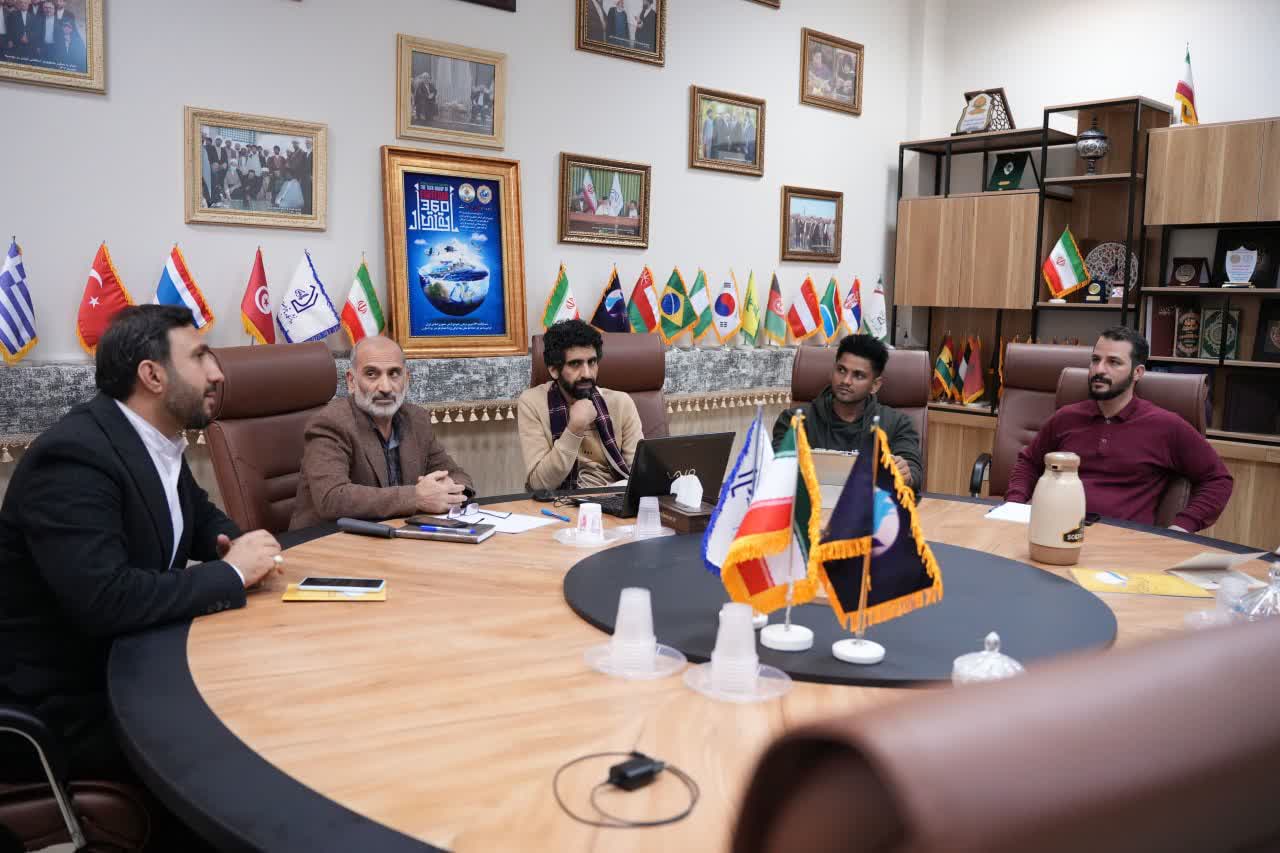
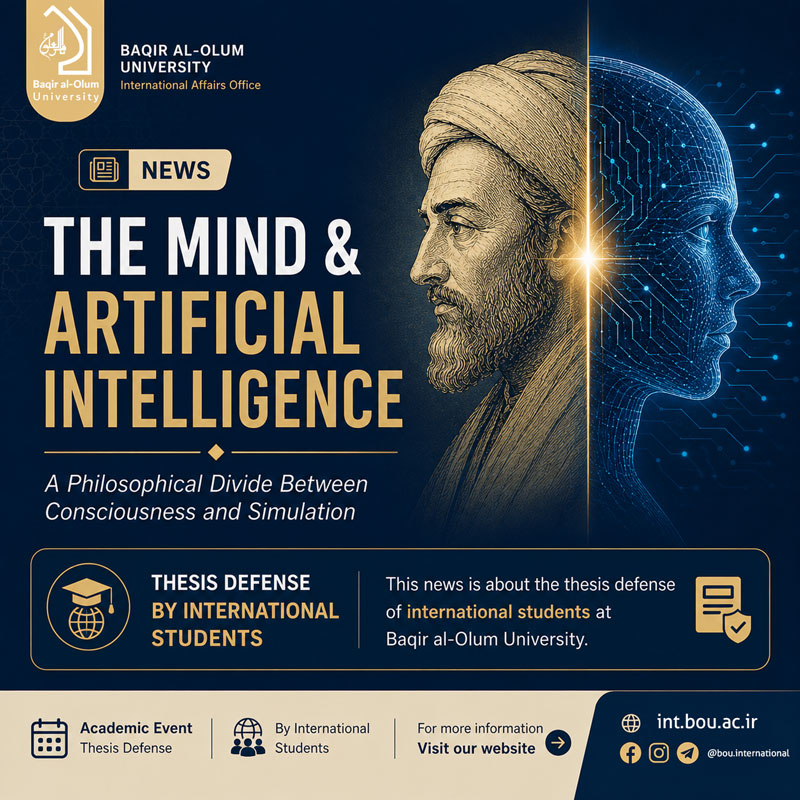
A thesis titled “The Mind in Mullā Ṣadrā’s Metaphysics and Artificial Intelligence” was successfully defended by an international student at Baqir al-Olum University.
The study explores the fundamental distinction between human consciousness and AI simulations, emphasizing that artificial intelligence cannot attain true knowledge or genuine awareness.
📌 Read the full news on our website.
Thesis
For degree of master of science
In Islamic Philosophy
Title:
An Examination of the Nature of Mind from the Perspective of Mullā Ṣadrā with an Emphasis on the Challenges Arising from the Emergence of Artificial Intelligence
Supervisor:
Dr. Hasan Abdi
Advisor:
Ḥujjat al-Islām wa al-Muslimīn Shujāʿ Ali Mirzā
Abstract
Mullā Ṣadrā, one of the most respected thinkers in Islamic philosophy, has both profound and complex notions regarding the mind. In al-Hikmat al-Muta‘āliyah, he describes the mind as a power of the soul, its manifestation, and eventually to be one with it—all supporting its immateriality. The mind must also be immaterial because knowledge is immaterial, and the locus of knowledge, the mind, must therefore be immaterial instead of material. These definitions do not contradict one another, but rather show different aspects of a unified, metaphysical understanding that is indicative of the ascent of the soul to higher realities. The advent of artificial intelligence (AI) stands in opposition of this position. AI, grounded in physicalism, assumes that the mind and consciousness emerge from material processes, thus striking against the question of an immaterial foundation of knowledge that is prominent in Ṣadriān / traditional metaphysics. The central inquiry of this thesis poses the following question: What intellectual and practical challenges does artificial intelligence pose to the Ṣadriān understanding of the mind? More specifically, secondary questions center on the nature of knowledge, the problem of free will, and whether artificial systems may have anything which could approximate genuine consciousness or intentionality.
This research is of a theoretical nature that involves making a philosophical comparison of the texts of Mullā Ṣadrā, for the purpose of articulating his understanding of the mind and contrasts that understanding with modern physicalist approaches in artificial intelligence. The study’s finding is that the mind, according to Ṣadrā, is an immaterial faculty of the soul based on the realm of acquired knowledge, and therefore, artificial systems—being material—cannot genuinely possess knowledge. Although intelligent behavior in AI systems can be simulated, the simulation is only functional not ontologically deep or self-aware such that it can claim consciousness. When the boundary between man and machine is obliterated or blurred, we risk undermining the theomorphic essence of humanity in the postmodern world. This thesis therefore aims to restore the immaterial and transcendent mind of the human being espoused by Mullā Ṣadrā as a metaphysical critique of physicalism and the illusion of artificial consciousness.
This thesis examines the philosophical conflict between the concept of the mind in Mullā Ṣadrā’s metaphysics and the assumptions of modern artificial intelligence. According to Mullā Ṣadrā, the mind is an immaterial reality and a faculty of the soul that enables genuine knowledge and consciousness. In contrast, AI is based on physicalist assumptions, viewing intelligence and consciousness as products of material processes.
The study argues that, although AI can imitate intelligent behavior, it cannot possess true knowledge, consciousness, or intentionality because it lacks an immaterial soul. By comparing Ṣadrā’s philosophy with contemporary AI theories, the thesis concludes that AI simulations should not be equated with genuine human consciousness and emphasizes the importance of preserving the metaphysical distinction between humans and machines.